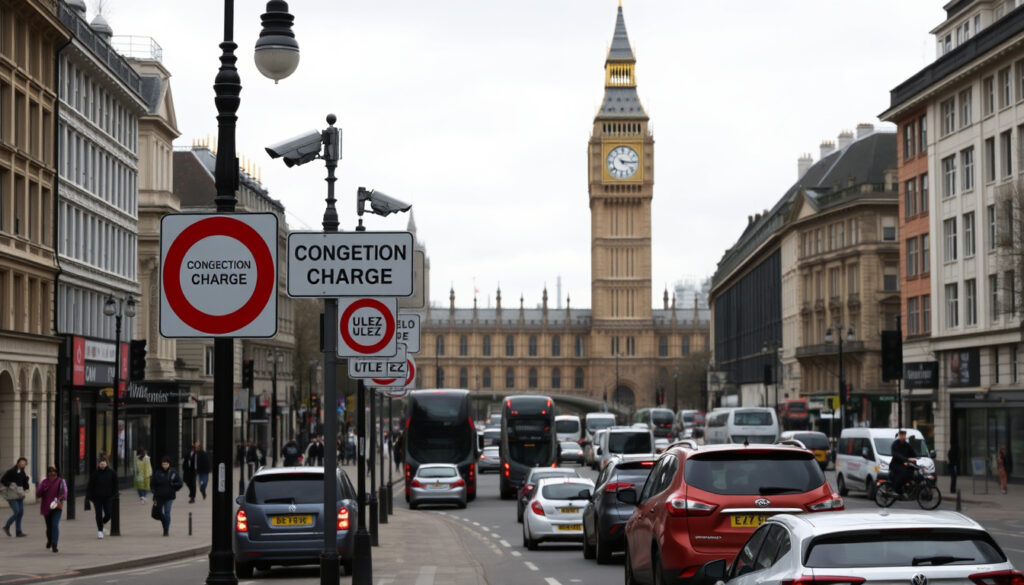
Pay to Drive in London: Congestion Charge & ULEZ Guide
If you’ve ever circled central London hunting for a parking spot while watching the meter tick toward £18 for the Congestion Charge, you already know that driving in the city costs more than just fuel. Two separate charges apply before you even factor in parking, and the rules shift depending on your vehicle type, the day of the week, and whether you’ve paid on time. This guide walks you through every official way to settle your bill, what happens if you don’t, and how to dodge the extra fees that unofficial websites sometimes add.
Congestion Charge: £18 daily if paid on day · Late Congestion Charge: £21 by midnight third day · Payment window: Up to 3 previous days or next day · ULEZ Charge: £12.50 daily for non-compliant vehicles · Operating hours: Mon-Fri 7am-6pm
Quick snapshot
- £18/day for on-time Congestion Charge payment (Transport for London, 2026 rate)
- £21/day for late payment by midnight third day (Transport for London, 2026 rate)
- £12.50/day for ULEZ non-compliant vehicles (Visit London)
- Payment via tfl.gov.uk, app, phone, or Auto Pay (Transport for London)
- Exact Blackwall and Silvertown tunnel charge amounts (pending TfL confirmation)
- Full eligibility criteria for all exemption and discount categories
- Exact ULEZ expansion timeline beyond current zone boundaries
- Shop/petrol station payments withdrawn (Top Tip London, 2013)
- EV full exemption ended (Electric Car Scheme, 2 January 2026)
- Congestion Charge rose to £18/£21 (Transport for London, January 2026)
- New Cleaner Vehicle Discount tiers introduced (Transport for London, January 2026)
- Tiered EV discounts replace full exemptions ((Transport for London, 2026))
- £13.50 for electric cars on Auto Pay (Transport for London, 2026)
- £9 for electric vans/HGVs/quadricycles on Auto Pay (Transport for London, 2026)
- Residents continue paying £1.80/day (Transport for London, 90% discount held)
The following table summarizes the key fees, effective dates, and penalty amounts.
| Charge type | Amount | Effective from |
|---|---|---|
| Congestion Charge (on-time payment) | £18 | January 2026 |
| Congestion Charge (late payment) | £21 | January 2026 |
| ULEZ daily charge | £12.50 | Ongoing |
| EV discount (Auto Pay, electric cars) | £13.50 | January 2026 |
| EV discount (Auto Pay, vans/HGVs/quadricycles) | £9 | January 2026 |
| Residents discount daily rate | £1.80 | January 2026 |
| PCN standard penalty | £180 | Ongoing |
| PCN reduced (within 14 days) | £90 | Ongoing |
TfL pay to drive in London
Two separate charges apply to drivers entering central London and much of Greater London. The Congestion Charge covers the central zone and targets traffic flow; the Ultra Low Emission Zone (ULEZ) applies across a wider area and targets vehicle emissions. Both must be paid separately through the same TfL system, and both carry the same midnight-third-day deadline.
What charges apply?
The Congestion Charge applies if you drive within the central London zone between 07:00 and 18:00 on weekdays, 12:00 and 18:00 on weekends and bank holidays. No charge runs between Christmas Day and New Year’s Day inclusive. The ULEZ applies to vehicles that do not meet the Euro 4 (petrol) or Euro 6 (diesel) emissions standards across a much larger area covering most of Greater London.
Payment options overview
You can settle both charges through four official channels: the TfL Pay to Drive in London app (free on iOS and Android), the official TfL website, the phone line (0343 222 2222 UK, +44 343 222 2222 international, Mon–Sat 06:00–00:00), or Auto Pay for regular commuters. Cash and card payments at shops or petrol stations stopped in 2013.
Transport for London (official government authority)
Pay Congestion Charge
The Congestion Charge targets solo drivers in the central London zone. Enforcement relies on Automatic Number Plate Recognition (ANPR) cameras with no physical barriers. The camera reads your number plate against the payment database—if you have paid, no issue; if you have not, a Penalty Charge Notice follows.
Costs and deadlines
From January 2026, the standard Congestion Charge rate is £18 per day if you pay on the same day as your journey or in advance. Miss that window, and the fee rises to £21 by midnight on the third day after travel. According to Transport for London’s payment page, you can also pay for up to three previous days, today, or the next day in a single transaction. If you fail to pay by the deadline, a Penalty Charge Notice for £180 lands on your vehicle’s registered keeper, reducing to £90 only if paid within 14 days.
Who must pay
Most private cars, vans, and trucks must pay. Full exemptions cover registered disabled blue badge holders, motorbikes, mopeds, and bicycles. Residents within the Congestion Charge zone qualify for a 90% discount paying just £1.80 per day after the 2026 increase, with an annual £10 application fee.
Electric vehicles lost their full Congestion Charge exemption on 2 January 2026. EV drivers now pay £13.50 per day through Auto Pay under the new Cleaner Vehicle Discount tier. Drivers who assumed EVs still cruise free need to register and pay immediately.
What this means: drivers who switched to EVs expecting permanent Congestion Charge relief now face a new payment obligation if they have not already set up Auto Pay.
Pay Congestion Charge online
The fastest way to sort your Congestion Charge payment is online. The process takes under five minutes if you already have a TfL account; first-time users need to register before they can pay.
Step-by-step online payment
Navigate to tfl.gov.uk/modes/driving/pay-to-drive-in-london and select “Pay Congestion Charge.” Choose your payment dates—you can select a single day or a range spanning up to three past days, today, or tomorrow. Enter your vehicle registration, the country of registration, and confirm your details before proceeding to payment. The system accepts most major credit and debit cards. You receive an email confirmation immediately upon successful payment.
Number plate lookup
The TfL system matches payments to number plates rather than cash transactions at gates. When you enter your registration, the system checks whether you have already paid for that date—if you are unsure, you can look up your vehicle’s payment status before attempting to pay. The Autotrader guide to the Congestion Charge confirms the app requires sign-in or account creation but the number plate lookup works even for unregistered users checking payment status.
Unofficial websites mimicking TfL have charged drivers up to £5 extra per transaction. Always start from tfl.gov.uk or download the official app from the App Store or Google Play. Transport for London explicitly warns against third-party sites that may mislead you into overpaying.
The implication: a quick detour to a copycat site can add a £5 surcharge to a charge that already costs £18—nearly a 28% premium for a site that provides no additional service.
Pay Congestion Charge by number plate
Number plate registration is the backbone of TfL’s enforcement. You do not need to carry a physical receipt—the camera system matches your plate to your payment record.
Using vehicle registration
Enter your vehicle registration exactly as it appears on your number plate, including any prefix letters indicating the country of registration (for example, “UK” for United Kingdom plates). The system accepts registrations for vehicles registered in the UK and several international jurisdictions. If you drive a foreign-registered vehicle, you still need to register and pay through the same portal.
Confirmation process
After payment, you receive a confirmation reference tied to your number plate. The TfL payment page confirms that once your payment is registered, cameras will read your plate and match it to your record—meaning you do not need to display anything in your vehicle. Check your email within minutes of payment for the confirmation; if it does not arrive, log into your TfL account to verify the payment status.
Pay ULEZ
The Ultra Low Emission Zone operates across most of Greater London and charges vehicles that do not meet the Euro 4 (petrol) or Euro 6 (diesel) emissions standards a flat daily fee.
ULEZ zone details
Unlike the Congestion Charge, which covers only the central London zone, the ULEZ extends across the entirety of Greater London (and slightly beyond in some directions). If your vehicle is registered outside London but you drive within Greater London, you still need to pay ULEZ if your car does not meet the standards. The zone operates 24 hours a day, 7 days a week, 365 days a year.
Charge amount
The ULEZ daily charge is £12.50 for non-compliant vehicles, according to Visit London’s traveller information page. You pay through the same TfL system used for the Congestion Charge—your payment covers both charges if you are entering both zones on the same day. Before paying, check whether your vehicle is compliant using TfL’s official compliance checker.
ULEZ and Congestion Charge overlap in central London, meaning a non-compliant diesel car entering the Congestion Charge zone on a weekday could face £30.50 in combined daily charges (£18 Congestion Charge + £12.50 ULEZ) before any late fees or PCNs. Paying on time keeps the total at the base rate.
The pattern: diesel drivers face a compounding penalty—first the ULEZ charge for emissions, then the Congestion Charge for entering central London—that together can exceed the cost of a single tank of fuel for the trip.
How to pay: step by step
Whether you prefer the website or the app, the payment workflow follows the same logic: select dates, enter your registration, confirm, and pay.
Pay via the TfL app
Download the TfL Pay to Drive in London app from Google Play or the App Store. Create an account or sign in if you already have one. Select “Pay Congestion Charge” or “Pay ULEZ” depending on which charge you need to cover. Use the calendar view to select your travel dates—you can pay for previous days, today, or the next day. Enter your number plate and confirm your vehicle details. Choose your payment method and complete the transaction. The app stores your payment history, making it easy to reference past transactions.
Pay via Auto Pay
Auto Pay suits regular commuters who enter the zone on set days each week. Set up your vehicle and preferred days in your TfL account, and TfL automatically charges your card at the start of each month for the days you selected. The 2026 Cleaner Vehicle Discount applies automatically through Auto Pay for qualifying electric vehicles—electric cars pay £13.50 per day instead of £18, and qualifying vans, HGVs, and quadricycles pay £9 per day.
Confirmed and unclear
The official TfL pages provide clear answers on costs, deadlines, and payment methods. Some areas remain less defined, particularly around exact exemption eligibility and future zone expansions.
Confirmed facts
- Congestion Charge costs £18 on-time, £21 late (from January 2026)
- ULEZ charges £12.50 for non-compliant vehicles
- Payment deadline is midnight on the third day after travel
- Auto Pay, app, website, and phone are the four official payment channels
- EV full exemption ended 2 January 2026
- Residents’ discount holds at £1.80/day after 2026 increase
- PCN for unpaid Congestion Charge starts at £180
- ANPR cameras enforce both charges with no physical barriers
What’s unclear
- Exact Blackwall and Silvertown tunnel charge amounts (pending TfL confirmation)
- Full eligibility criteria for all disability and specialist exemptions
- Whether ULEZ zone boundaries will expand further after current rollout
Don’t pay through unofficial websites which may mislead you. You should always pay the Congestion Charge with us on our secure online system.
— Transport for London, official payment guidance
The changes include an increased daily charge of £18 and a new tiered Cleaner Vehicle Discount for electric vehicles.
— Transport for London, 2026 Congestion Charge changes
Related reading: UK Minimum Wage Increase – New 2026 Rates Explained · 30000 After Tax UK – 2024/25 Net Pay Breakdown
Navigating the £18 Congestion Charge demands timely payment, much like the steps outlined in this Congestion Charge payment guide for times and checkers.
Frequently asked questions
What happens if I don’t pay Congestion Charge?
If you fail to pay by midnight on the third day after travel, TfL issues a Penalty Charge Notice for £180 to your vehicle’s registered keeper. Paying within 14 days reduces the fine to £90. The PCN is automatically generated when the ANPR cameras read your plate and find no matching payment.
Are electric vehicles exempt from ULEZ?
No. EVs no longer receive automatic exemption from Congestion Charge (the exemption ended 2 January 2026). However, EVs meeting the Euro 4 (petrol) or Euro 6 (diesel) standards are exempt from ULEZ because they produce zero tailpipe emissions. The Cleaner Vehicle Discount also applies to qualifying EVs through Auto Pay.
How to check my vehicle ULEZ compliance?
Use the official TfL compliance checker tool available on the TfL website. Enter your vehicle registration and the system will tell you whether your car meets the Euro 4 (petrol) or Euro 6 (diesel) standards required to avoid the ULEZ charge.
Can tourists pay to drive in London?
Yes. Tourists can pay the Congestion Charge and ULEZ using the TfL app or website. Foreign-registered vehicles are accepted in the system. You do not need a UK bank account—most major international credit and debit cards are accepted. Plan ahead and pay before or on the day you drive to avoid the higher late fee.
What is the difference between Congestion Charge and ULEZ?
The Congestion Charge covers only the central London zone and targets traffic reduction. The ULEZ covers most of Greater London and targets emissions from high-polluting vehicles. Both charges apply simultaneously in the central zone, meaning a non-compliant vehicle could face both fees on the same day.
How to get a Congestion Charge refund?
If you paid for a day you did not drive in the zone, you can request a refund through your TfL account. Refunds are considered if the payment was a duplicate, if you paid in error, or in exceptional circumstances. Log into your account, find the relevant payment, and select “request a refund.” TfL reviews refund requests within a set timeframe.
Does Congestion Charge apply on weekends?
Yes, the Congestion Charge applies on Saturdays, Sundays, and bank holidays, but during different hours: 12:00 to 18:00 rather than the weekday 07:00 to 18:00. Christmas Day through New Year’s Day bank holiday are exempt from the charge entirely.
More related posts
 Clifford the Big Red Dog: True Story, Size & LGBTQ Characters
 Katie Price Latest News: New Husband After JJ Split
 MAFS Australia Season 12: Couples Still Together & Cast Now
 Ikea Wardrobe Guide: Best Options for Small Rooms & Dublin Homes
 Members of the Mamas and the Papas: Original 4 Fates
 Tinker Tailor Soldier Spy: Book, TV Miniseries & Film Guide
 What Is an Adverb? Definition, Examples & How to Identify Them
 F1 Start Time UK – British Grand Prix 2026 Schedule