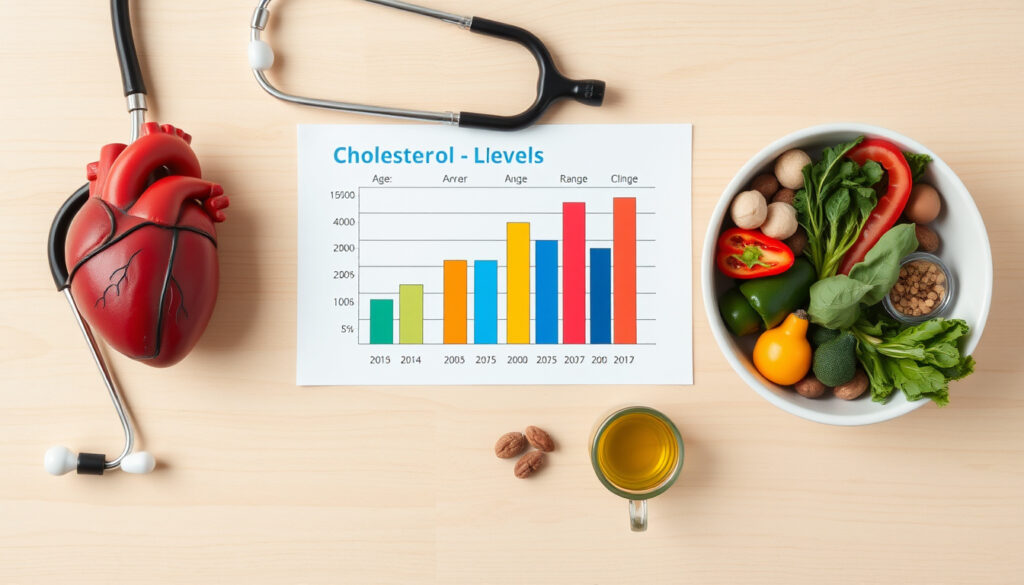
Cholesterol Levels by Age Chart: Normal Ranges & How to Lower
When your doctor hands you a cholesterol test result, the numbers can feel like a foreign language. This guide breaks down what those numbers mean at every stage of life, using official UK guidelines to help you interpret your results.
Average total cholesterol (age 0-19): 150 mg/dL (3.9 mmol/L) ·
Average total cholesterol (age 20-39): 180 mg/dL (4.7 mmol/L) ·
Average total cholesterol (age 40-59): 220 mg/dL (5.7 mmol/L) ·
Average LDL cholesterol (age 20-39): 120 mg/dL (3.1 mmol/L) ·
Average HDL cholesterol (age 20-59): 50 mg/dL (1.3 mmol/L)
Quick snapshot
- Total cholesterol avg 220 mg/dL (5.7 mmol/L) (Cleveland Clinic)
- LDL may rise to 140 mg/dL, HDL remains ~50 mg/dL (Cleveland Clinic)
- Increased cardiovascular risk requires monitoring (Cleveland Clinic)
- Statins often considered if LDL > 3.4 mmol/L (Cleveland Clinic)
- Total cholesterol may decrease slightly after 70 (NHS UK)
- LDL target may be lower if heart disease present (NHS UK)
- Maintaining HDL >40 mg/dL is beneficial (NHS UK)
- Focus on overall risk reduction (NHS UK)
Five key measurements, one pattern: healthy cholesterol numbers shift with age, and the thresholds that matter most depend on your overall cardiovascular risk profile.
| Measurement | Target for healthy adults (UK) | Target for high-risk / CVD patients |
|---|---|---|
| Total cholesterol | Below 5.0 mmol/L (NHS UK) | Below 4.0 mmol/L (if secondary prevention) |
| Non-HDL cholesterol | Below 4.0 mmol/L (NHS UK) | At least 40% reduction from baseline (NICE UK) |
| LDL cholesterol | Below 3.0 mmol/L (Heart UK) | Below 2.0 mmol/L (NICE UK) |
| HDL cholesterol (men) | Above 1.0 mmol/L (NHS UK) | Same target |
| HDL cholesterol (women) | Above 1.2 mmol/L (NHS UK) | Same target |
| Triglycerides (fasting) | Below 1.7 mmol/L (Heart UK) | Same target |
| Triglycerides (non-fasting) | Below 2.0 mmol/L (Heart UK) | Same target |
For the average UK adult without other risk factors, total cholesterol below 5.0 mmol/L is the gold standard. But if you already have heart disease or diabetes, your targets tighten significantly — and that’s where age-specific charts become less useful than a personalised risk assessment.
What is a normal cholesterol level by age?
In the UK, the NHS doesn’t publish a single “normal” value because targets are personalised based on your age, sex, and cardiovascular risk profile (NHS UK). However, population averages give a useful benchmark. The Cleveland Clinic (US medical centre) notes that normal cholesterol levels vary by age, ethnicity and sex, so broad ranges apply.
What is a normal cholesterol reading for a 70 year old?
- Total cholesterol often drops slightly after age 70, but LDL targets may be stricter if heart disease is present (Heart UK).
- For a healthy 70-year-old with no CVD history, total cholesterol below 5.0 mmol/L is still the ideal (NHS UK).
- HDL tends to decrease with age; maintaining above 1.0 mmol/L (men) or 1.2 mmol/L (women) is beneficial.
What are normal cholesterol levels for adults?
- Total cholesterol: below 5.0 mmol/L (Heart UK)
- Non-HDL: below 4.0 mmol/L (NHS UK)
- LDL: below 3.0 mmol/L (Heart UK)
- HDL: above 1.0 mmol/L for men, above 1.2 mmol/L for women (NHS UK)
- Triglycerides (fasting): below 1.7 mmol/L (Heart UK)
What are cholesterol levels by age chart for females?
Women typically have higher HDL cholesterol than men throughout life, especially before menopause. For women, healthy HDL is above 1.2 mmol/L, and levels around 1.4 mmol/L are thought to offer the best protection (Heart UK). After menopause, total cholesterol and LDL levels may rise.
What are cholesterol levels by age chart for males?
Men tend to have lower HDL (above 1.0 mmol/L is acceptable) and higher triglycerides than women at similar ages. The NHS advises that healthy total cholesterol levels below 5.0 mmol/L apply equally to men and women, but the HDL threshold is sex-specific (NHS UK).
The implication is that generic charts are less helpful than a conversation with your GP about your individual risk profile.
Is a cholesterol reading of 6.5 high?
Yes. In the UK, total cholesterol of 6.5 mmol/L (around 250 mg/dL) is considered high and warrants discussion with your GP about lifestyle changes and possibly medication (NHS UK). The risk increases if your LDL is also elevated or if you have other risk factors like diabetes or family history of heart disease.
Is a cholesterol level of 5.7 high?
A reading of 5.7 mmol/L is borderline high. The Heart UK (cholesterol charity) categorises this as “above the ideal level” and recommends lifestyle changes. If your LDL is above 3.0 mmol/L or your non-HDL is above 4.0 mmol/L, your doctor may suggest more aggressive targets.
What is stroke level high cholesterol?
There is no officially defined “stroke level” for cholesterol, but the risk of stroke rises significantly when LDL cholesterol exceeds 4.0 mmol/L (NICE UK guidance). The key is not a single number but your cumulative risk score (including blood pressure, smoking, diabetes).
A cholesterol reading of 6.5 mmol/L doesn’t guarantee a heart attack, but ignoring it while other risk factors pile up is a gamble. The person who faces the clearest consequence is the one who does nothing about it.
The pattern is clear: borderline or high readings demand action, but the urgency depends on your full risk picture.
How can I lower my cholesterol from 6 to 4?
A reduction of 2 mmol/L is achievable for many people through a combination of diet, exercise and, when needed, medication. Here’s a step-by-step plan based on UK guidelines.
- Cut saturated fat. Replace butter, fatty meats and full-fat dairy with unsaturated fats from olive oil, nuts and avocados. Saturated fats are the primary dietary cause of high LDL (NHS UK).
- Eat more soluble fibre. Oats, beans, lentils, apples and psyllium can lower LDL by 5-15% (Heart UK).
- Add plant stanols and sterols. Fortified yoghurts and drinks containing 2-3g per day can reduce LDL by 7-10% (Heart UK).
- Exercise regularly. 150 minutes of moderate activity per week helps raise HDL and lower LDL (NHS UK).
- Consider medication. If after three months of lifestyle change your total cholesterol remains above 5.0 mmol/L (or above 4.0 mmol/L if you’re at high risk), your GP may prescribe a statin (NICE UK).
What flushes cholesterol out of your body?
Nothing “flushes” cholesterol. The body removes it through bile acids, which are excreted in the stool. Soluble fibre binds to bile acids and helps eliminate them, prompting the liver to use more cholesterol to produce new bile (Heart UK). Drinking plenty of water supports kidney function but does not directly remove cholesterol.
What drink is good for lowering cholesterol?
Green tea and oat milk (enriched with plant stanols) have shown modest LDL-lowering effects. One small study found that drinking three cups of green tea daily could reduce LDL by 2-3%. Plant-based milks fortified with 2g of stanols per serving are a practical option (Heart UK).
Diet alone rarely drops cholesterol from 6.5 to 4.0 mmol/L. Most people who achieve that reduction combine a low-saturated-fat diet with a statin. The trade-off is real: medication is effective, but it requires a commitment to long-term prescription.
The implication is that you should not delay a conversation with your GP if your numbers are high.
What is the number one food that causes high cholesterol?
Foods high in saturated fats — particularly red meat, butter, cheese, and tropical oils like coconut oil — are the biggest dietary contributors to elevated LDL cholesterol (NHS UK). The NHS advises limiting saturated fat to no more than 20g per day for women and 30g for men.
Will 2 eggs a day raise my cholesterol?
For most people, dietary cholesterol from eggs has a much smaller effect on blood cholesterol than saturated fat. Studies suggest that eating up to two eggs per day does not significantly increase heart disease risk in healthy individuals (Heart UK). However, people with existing high cholesterol or diabetes should consult their doctor.
Are Heinz baked beans good for cholesterol?
Yes, because they are high in soluble fibre. A half-can of baked beans provides about 5g of fibre, contributing to the 25-30g daily recommended intake. The British Heart Foundation recommends beans and pulses as part of a heart-healthy diet, though the added sugar and salt in some brands should be considered.
The catch is that processed versions of otherwise healthy foods can undermine your efforts if they contain added sugars and salt.
What drink is good for lowering cholesterol? (Revisited: evidence-based choices)
While no drink can replace the effect of a statin or a low-fat diet, certain beverages can support cholesterol reduction as part of an overall plan.
| Drink | Potential effect on LDL | Mechanism |
|---|---|---|
| Green tea | Modest reduction (2-5%) | Antioxidants (catechins) may reduce absorption (Heart UK) |
| Oat milk (fortified with stanols) | Up to 10% reduction | Plant stanols block cholesterol absorption (Heart UK) |
| Soy milk | Modest reduction (3-5%) | Contains unsaturated fats and plant compounds |
| Alcohol (in moderation) | May raise HDL | But excess raises triglycerides (NHS UK) |
One drink stands out: oat milk with added plant stanols offers the largest proven LDL reduction per serving for a drink (Heart UK). But remember, drinks are supporting players, not the main cast.
The pattern is that while drinks can help modestly, they should never replace core dietary and medical interventions.
Confirmed facts vs. what remains unclear
Confirmed facts
- High levels of LDL cholesterol increase risk of stroke and heart disease (NHS UK)
- Lifestyle changes (diet, exercise) can lower cholesterol by up to 20% (Heart UK)
- Age is a factor in cholesterol levels; target ranges vary by age (Cleveland Clinic)
What’s unclear
- Whether Heinz baked beans significantly lower cholesterol (evidence is indirect)
- Whether eating two eggs daily raises cholesterol in most people (studies show mixed results)
- The exact threshold for “stroke level” high cholesterol (it’s a cumulative risk, not a single number)
The implication is that you should act on what is proven, while not overinterpreting uncertain claims.
Quotes from health authorities
“A good target level for you depends on things like your age, whether you have any health conditions and your risk of cardiovascular disease.”
NHS UK (public health authority)
“Normal cholesterol levels vary based on your age, ethnicity and sex.”
Cleveland Clinic (US medical centre)
The NHS says targets are “personalised” while the Cleveland Clinic says they “vary by age”. Both are right — but that variability means you cannot rely on a one-size-fits-all chart. The real judgment belongs to your GP after a full risk assessment.
What this means is that your cholesterol numbers must be interpreted in the context of your overall health, not by a chart alone.
Summary
Cholesterol levels shift with age, but the goalposts change depending on your overall health profile. For a 50-year-old in the UK with no other risk factors, a total cholesterol below 5.0 mmol/L is a sensible target. For someone with diabetes or existing heart disease, the bar is lower — LDL under 2.0 mmol/L. The decision is clear: work with your GP, adjust your diet, and accept medication if needed. Ignoring the numbers is the one move that guarantees a worse outcome.
benecol.co.uk, reposehealthcare.co.uk, lolahealth.com, medlineplus.gov, bhf.org.uk
For those in the United Kingdom, it is important to compare these ranges with UK NHS cholesterol targets to account for local measurement standards.
Frequently asked questions
What are normal cholesterol levels for women?
For women, healthy total cholesterol is below 5.0 mmol/L, LDL below 3.0 mmol/L, HDL above 1.2 mmol/L, and non-HDL below 4.0 mmol/L. HDL around 1.4 mmol/L offers the best protection (Heart UK).
What are normal cholesterol levels for men?
For men, total cholesterol below 5.0 mmol/L, LDL below 3.0 mmol/L, HDL above 1.0 mmol/L, and triglycerides below 1.7 mmol/L (fasting) (NHS UK).
What are the target cholesterol levels for a 70-year-old with or without heart disease?
For a healthy 70-year-old, total cholesterol below 5.0 mmol/L and LDL below 3.0 mmol/L are general targets. If heart disease is present, LDL below 2.0 mmol/L may be recommended. HDL should remain above 1.0 mmol/L (men) or 1.2 mmol/L (women) (NHS UK).
What LDL cholesterol level is associated with increased stroke risk?
Stroke risk rises significantly when LDL exceeds 4.0 mmol/L. However, overall risk depends on blood pressure, diabetes, smoking and family history (NICE UK).
Does daily egg consumption affect cholesterol levels in healthy adults?
For most healthy people, up to two eggs per day does not significantly raise blood cholesterol. The bigger concern is what you eat them with — bacon and buttered toast are higher in saturated fat (Heart UK).
More related posts
 Best Ear Wax Removal Kit 2025: Audiologist Picks & Safety Guide
 Members of the Mamas and the Papas: Original 4 Fates
 Is Ketamine an Opioid – Drug Class, Differences Explained
 Michelle Williams Movies and TV Shows: The Full List
 What Is Social Media? Definition, Examples & Top Platforms
 Oklahoma City Thunder vs Pacers Player Stats & Game Results
 What Time Is Iftar Today? Dublin Iftar Times & Ramadan Guide
 Cast of Missing You 2025: Full List and Characters Explained