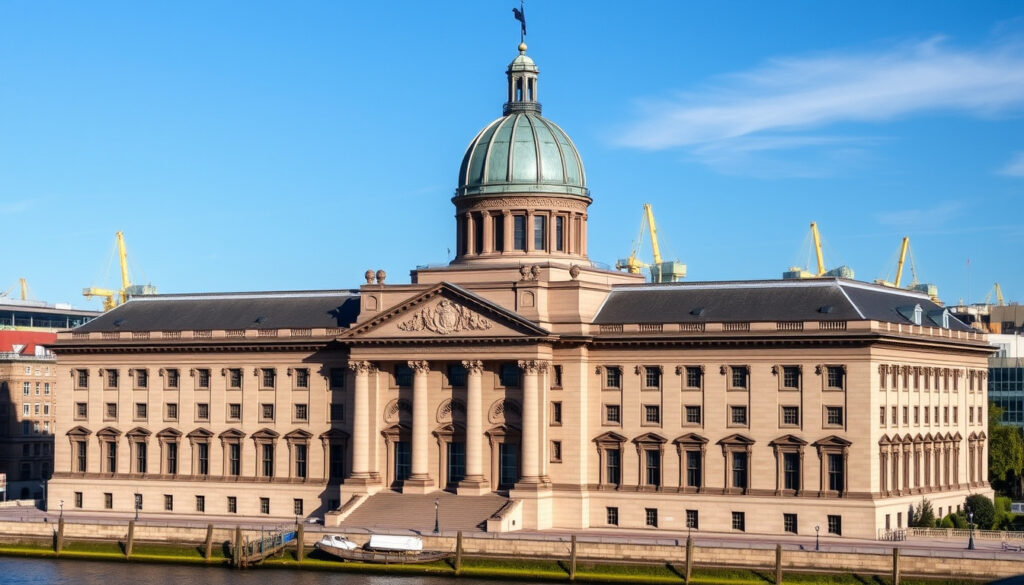
Capital of Northern Ireland: Belfast Facts, History & UK Role
Most people know Belfast as the Titanic’s birthplace, but fewer can explain exactly why this city became Northern Ireland’s capital—and why Ireland ended up with two of them. That ambiguity creates genuine confusion: a place that’s simultaneously Irish, British, and something more complicated than either label suggests. The answer sits at the intersection of geography, colonial history, and a 1921 partition that nobody wanted but everyone accepted to avoid civil war.
Capital of Northern Ireland: Belfast ·
Part of: United Kingdom ·
Largest City: Belfast ·
Location: River Lagan banks
Quick snapshot
- Belfast is the capital and principal port on the River Lagan (Britannica)
- Belfast became a city by royal charter in 1888 (Britannica)
- Population: 352,390 in 2024 (metro area: 671,559) (Wikipedia)
- Exact current demographic shifts post-2022
- Whether future referendums on Irish reunification will proceed
- Good Friday Agreement (1998) established power-sharing; tensions resurface periodically
- Population growth continues; Belfast’s Titanic Quarter drives tourism economy
The following table consolidates verified data points about Belfast’s role as Northern Ireland’s capital, drawing from authoritative sources on geography, governance, and urban metrics.
| Label | Value |
|---|---|
| Capital City | Belfast |
| Country | United Kingdom |
| Region | Northern Ireland |
| City Status | Royal charter granted 1888 |
| Area | 115 square km |
| Key Site | River Lagan port, Belfast Lough |
Is Belfast the capital of Northern Ireland?
Yes, and it has been since the Government of Ireland Act came into force on 3 May 1921. The city serves as the seat of Northern Ireland’s devolved government, housed in Parliament Buildings at Stormont on the outskirts. Belfast is not just an administrative center—it also functions as the region’s largest urban area and its principal port, handling the majority of Northern Ireland’s maritime trade.
Location and role
Belfast, from the Irish Béal Feirste meaning “Mouth of the Farset,” sits on the River Lagan where it flows into Belfast Lough, a position that made it ideal for industrial development in the 19th century (Irish Tourism). The city covers approximately 115 square kilometers and remains the largest urban center in Northern Ireland and Ulster, second only to Dublin across the entire island of Ireland. Its industrial legacy includes the Titanic, built in the city’s famous Harland and Wolff shipyard between 1909 and 1912. Today, the Titanic Quarter anchors Belfast’s tourism economy.
Historical context
Belfast received its city status by royal charter in 1888, well before partition. When the Government of Ireland Act created separate parliaments in Belfast and Dublin, it designated Belfast as the capital of the newly formed Northern Ireland state. The choice reflected both population size and industrial prominence—Belfast was already the island’s largest city outside Dublin.
What are the 4 capitals of the UK?
The United Kingdom of Great Britain and Northern Ireland comprises four constituent nations, each with its own capital city. This structure distinguishes the UK from most other sovereign states, which typically have a single capital.
England, Scotland, Wales, Northern Ireland
- London – capital of England and the UK’s primary seat of government
- Edinburgh – capital of Scotland
- Cardiff – capital of Wales
- Belfast – capital of Northern Ireland
Each capital hosts its nation’s devolved parliament or assembly, except London, which houses the UK-wide Parliament. Northern Ireland’s parliament at Stormont handles domestic matters transferred from Westminster under the Good Friday Agreement framework.
United Kingdom structure
The UK operates as a unitary state with devolved administrations. According to Britannica, this arrangement means that while Belfast functions as Northern Ireland’s capital, foreign policy and defense remain Westminster’s responsibility. Scotland, Wales, and Northern Ireland each have varying degrees of autonomy over education, health, and local government.
Why does Ireland have two capitals?
The answer lies in the partition of Ireland in 1921. Before that date, the entire island shared a single administrative structure under British rule, with Dublin as the primary seat. Partition changed everything.
Partition history
Facing the threat of civil war between Irish nationalists and British authorities, the UK Parliament passed the Government of Ireland Act in 1920. The legislation partitioned the island into two separate jurisdictions: Northern Ireland (six Ulster counties with a Protestant majority) and Southern Ireland (26 counties). The Anglo-Irish Treaty, signed in December 1921, formalized this division and established the Irish Free State from the southern portion in 1922.
Partition violence in Belfast between 1920 and 1922 killed over 500 people and displaced more than 10,000, mostly Catholics fleeing pogroms. The death toll and displacement shaped the city’s sectarian geography that persists today.
Republic vs Northern Ireland
Dublin became the capital of the Irish Free State, which later became the Republic of Ireland in 1949. Belfast remained the capital of Northern Ireland, which stayed within the United Kingdom. This created the unusual situation where two capitals now serve populations that were once unified under Dublin’s administration.
As Britannica explains, partition was designed to create two Home Rule territories, both remaining in the UK. The Republic of Ireland subsequently left the Commonwealth, while Northern Ireland stayed. The border between them remains one of the few land borders within the British Isles.
Is Belfast Irish or British?
This question has no single answer, which is precisely why it generates so much debate. Legally, Belfast is part of the United Kingdom. Politically, residents hold divided allegiances that the 1998 Good Friday Agreement attempted to accommodate rather than resolve.
Political status
Belfast residents can hold British citizenship, Irish citizenship, or both simultaneously. Northern Ireland’s constitution allows what the Good Friday Agreement called “the birthright of all the people of Northern Ireland to identify themselves and be accepted as Irish or British, or both.” This dual citizenship arrangement is unique in Europe.
Approximately one-third of Northern Ireland’s 1.81 million population lives in the Belfast metropolitan area. Demographic surveys show the city remains divided along sectarian lines, with Catholic and Protestant neighborhoods often separated by “peace lines”—walls built during the Troubles that still stand today.
Nationality debates
Nationalist communities in Belfast typically identify as Irish and prefer reunification with the Republic. Unionist communities identify as British and prefer remaining in the UK. Neither side holds a majority across Northern Ireland as a whole, which is why the question of identity remains perpetually contested.
Political parties such as Sinn Féin (Nationalist) and the Democratic Unionist Party (DUP) represent these opposing viewpoints in Stormont’s power-sharing executive. The tension between these perspectives shapes nearly every policy debate, from education to language rights to how history gets taught in schools.
What are the capital cities in the United Kingdom?
Understanding the UK’s four capitals requires grasping the union’s historical formation. England, Scotland, Wales, and Ireland were gradually unified into a single state between the 12th and 18th centuries, with each maintaining certain institutions.
Four nations overview
The Kingdom of England incorporated Wales in 1536, unified with Scotland in 1707 to form Great Britain, and absorbed Ireland in 1801 to create the United Kingdom. When Ireland partitioned in 1921, the UK became the United Kingdom of Great Britain and Northern Ireland—the name it carries today.
Each capital developed its distinct character over centuries. London’s influence spans global finance and politics. Edinburgh houses Scotland’s legal system and Presbyterian Church. Cardiff represents Wales’s Celtic language and culture revival. Belfast reflects Northern Ireland’s contested status and industrial heritage.
Geographic spread
The capitals span the island of Great Britain plus Northern Ireland, making the UK one of the few states with territories on multiple islands. London sits in the southeast; Edinburgh in the northeast; Cardiff in the west; Belfast on the island of Ireland’s northeastern coast. This geographic distribution means the UK’s governance structure is unusually decentralized compared to other European nations.
The confusion around Belfast’s status isn’t mere trivia—it reflects a live political debate. Polls show support for Irish reunification hovering around 35-40%, but rising among younger voters. If that number crosses 50%, a border referendum could change everything.
Belfast built the Titanic—a ship designed to carry people away from Ireland. Today, the Titanic Quarter draws tourists from around the world. The city’s history of departure has become its greatest attraction.
Confirmed facts
- Belfast is capital of Northern Ireland
- UK has four capitals (London, Edinburgh, Cardiff, Belfast)
- Partition enacted 3 May 1921
- Good Friday Agreement signed 10 April 1998
- Belfast population: 352,390 in 2024
- City status granted by royal charter in 1888
Unclear / contested
- Exact timing of any future reunification referendum
- Current religious demographic breakdown
- Whether power-sharing will remain stable long-term
What people say
The Government of Ireland Act was designed to create two separate Home Rule territories, both of which would remain in the United Kingdom.
— Stewart Weaver, University of Rochester historian
Facing civil war in Ireland, Britain partitioned the island in 1920.
— Britannica editorial team
Summary
Belfast’s status as Northern Ireland’s capital emerged from a political compromise nobody wanted but everyone accepted to prevent civil war. A century later, the arrangement holds but tensions simmer. For visitors, Belfast offers a vibrant city with world-class heritage sites. For political analysts, it represents one of Europe’s most complex constitutional questions. Whether Belfast remains “British” depends largely on what happens at the next election cycle—and the next decade may answer questions that 1921 left deliberately unresolved.
Related reading: UK Minimum Wage Increase · 30000 After Tax UK
en.wikipedia.org, rochester.edu, youtube.com, ukandeu.ac.uk, visitbelfast.com, youtube.com
Belfast’s rich academic legacy includes prominent institutions like Queens University Belfast, founded in 1845 as Queen’s College to expand higher education across Northern Ireland.
Frequently asked questions
What is the population of Northern Ireland?
Northern Ireland has a population of approximately 1.81 million, representing about 28% of the island of Ireland’s total population.
What language is spoken in Northern Ireland?
English is the primary language. Irish Gaelic has official recognition and is taught in some schools. Ulster Scots also has recognition in limited contexts. Most residents speak English as their first language.
What is the flag of Northern Ireland?
Northern Ireland does not have an officially designated national flag. The Union Jack represents the UK as a whole. The Ulster Banner (a variation of the Red Flag with a crowned six-point star) is used informally by some unionist organizations but is not officially recognized.
What is Northern Ireland’s nationality status?
People born in Northern Ireland can hold British citizenship, Irish citizenship, or both under the Good Friday Agreement’s provisions. This dual entitlement is unique among UK territories.
Is there a border between Northern Ireland and the Republic of Ireland?
Yes, there is a land border between Northern Ireland (UK) and the Republic of Ireland (EU). Post-Brexit, this border became more complex due to the Northern Ireland Protocol, which created special arrangements for trade to avoid a hard border on the island of Ireland.
What happened during the Troubles?
The Troubles (late 1960s to 1998) involved violence between Protestant unionists seeking to remain in the UK and Catholic nationalists seeking a united Ireland. Over 3,500 people died in the conflict. The Good Friday Agreement in 1998 largely ended the violence and established power-sharing government.
What is Sinn Féin?
Sinn Féin is a political party that historically supported Irish reunification and was linked to the IRA during the Troubles. Today it is the largest nationalist party in Northern Ireland and also operates in the Republic of Ireland. The name comes from Irish and translates roughly to “We ourselves” or “Our Ireland.”
More related posts
 Villarreal vs Real Madrid: Head-to-Head, Stats & 2026 Result
 Miniature Poodle: Complete Breed Guide, Pros & Cons, and Training Tips
 What Do Fleas Look Like? Adults, Eggs, Larvae & Pupae
 Rosemary Oil for Hair: Benefits, Risks & How to Use
 Moderate High Temperature Warning: Celsius Meaning & Criteria
 This City Is Ours Season 2: BBC Renewal, Cast & Release
 Gutter Repair Near Me – Costs, Signs & Local Services
 Patsy Palmer: Biography, Career, Family & Net Worth (2025 Guide)