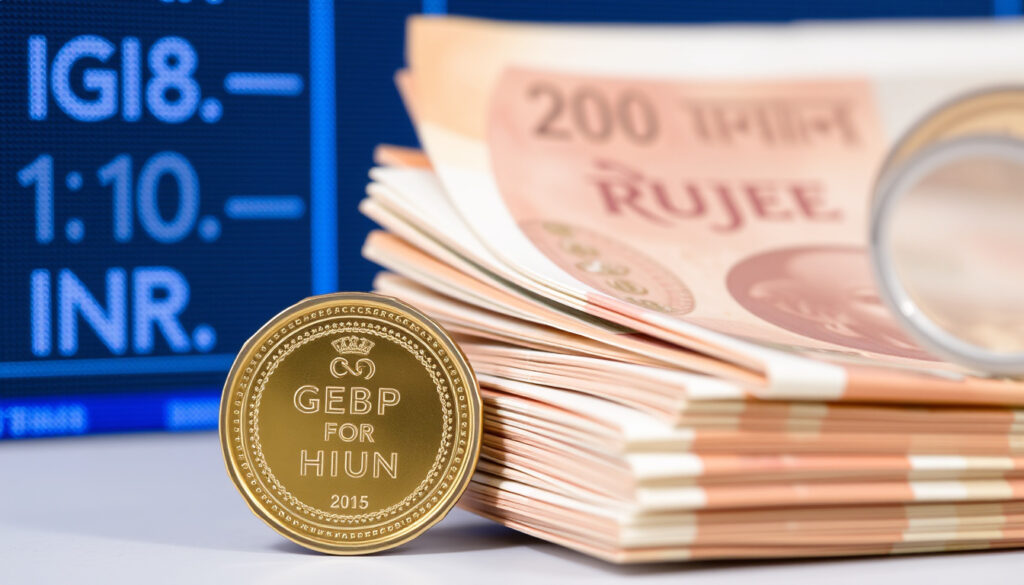
1 British Pound to Indian Rupee: £1 in INR Rate
If you’ve ever sent money to India or planned a trip to Kerala, you’ve probably asked yourself one simple question: how much is a pound actually worth in rupees? The answer shifts every day, but the story behind it stretches back to 1947, when a single pound bought you ₹13.33 — and today that same pound gets you around ₹127.80, and the difference tells you a lot about how two economies have changed over eight decades.
1 GBP to INR (mid-market): ₹127.80 ·
1 USD to INR: ₹83.50 ·
1 EUR to INR: ₹111.08 ·
1 INR to GBP: £0.0078 ·
1 USD to INR in 1947: ₹4.79
Here is a side-by-side comparison of the three major currencies against the Indian rupee, showing current mid-market rates and the total change since 1947.
| Currency | Mid-market rate (June 2025) | Rate in 1947 | Total change |
|---|---|---|---|
| British pound (GBP) | ₹127.80 | ₹13.33 | ~859% increase |
| US dollar (USD) | ₹83.50 | ₹4.79 | ~1,643% increase |
| Euro (EUR) | ₹111.08 | N/A (introduced 1999) | N/A |
Quick snapshot
- 1 GBP ≈ ₹127.80 mid-market as of June 2025 (XE (currency data provider))
- 1 USD in 1947 was fixed at ₹4.79 (Reserve Bank of India (central bank))
- 1 lakh = 100,000 INR; 1 crore = 10,000,000 INR (XE (currency data provider))
- Exact future direction of GBP/INR and USD/INR depends on monetary policy and global growth
- Whether the RBI will intervene to slow rupee depreciation beyond current levels
- Whether ₹1 lakh per month is still a liveable salary in Mumbai or Delhi (cost of living varies)
- 1947: 1 GBP = ₹13.33 (fixed peg); 1 USD = ₹4.79 (Wikipedia (encyclopedia))
- 1966: Rupee devalued 57% — 1 GBP jumps to ₹17.76 (BookMyForex (currency exchange platform))
- 1991: Liberalisation; rupee floats; 1 GBP ≈ ₹40 (BookMyForex (currency exchange platform))
- 2020–2025: GBP/INR crosses 100 and stays above 120 (XE (currency data provider))
- Analysts expect the rupee to remain under pressure if US Fed rates stay high
- India’s trade deficit and inflation may push USD/INR towards 85–90
- Digital tools (Wise, Revolut) offer mid-market rates with low fees — undercutting bank spreads
Six key rates, one pattern: the pound has consistently traded higher than the dollar and euro against the rupee, but all three have gained as the rupee has steadily weakened over the decades.
Here are the main figures you need for quick reference.
| Label | Value |
|---|---|
| Current GBP/INR mid-rate | ₹127.80 (June 2025) |
| Current USD/INR mid-rate | ₹83.50 |
| Current EUR/INR mid-rate | ₹111.08 |
| 1 lakh INR in GBP | £781 |
| 1 crore INR in GBP | £78,100 |
| 1 USD to INR in 1947 | ₹4.79 |
How much is 1 British pound in Indian rupees today?
Current live rate for GBP/INR
- The mid-market exchange rate as of June 2025 is approximately ₹127.80 per £1, according to XE (currency data provider). This is the rate you see on Google and used by digital transfer services such as Wise (money transfer platform) before fees.
- Banks and airport exchange counters typically add 3–5% to this rate. The actual amount you receive may be ₹121–124 if you exchange cash.
How to convert pounds to rupees yourself
- Take the amount in GBP.
- Multiply by the current rate (e.g., £100 × 127.80 = ₹12,780).
- Subtract any transfer or conversion fee (usually 0.5–3%).
If you use a service like Wise or Revolut, you get the mid-market rate + a transparent fee. If you use a high-street bank, the exchange rate is often marked up by 2–4%.
What affects the pound-to-rupee exchange rate?
- Bank of England interest rates: When the BoE raises rates, the pound tends to strengthen against the rupee, as foreign investors seek higher yields in sterling assets.
- India’s trade balance: India imports more than it exports, creating a constant demand for foreign currency, which pushes the rupee lower. According to the Reserve Bank of India (central bank), the current account deficit has put pressure on the rupee.
- Inflation differential: India’s consumer price inflation tends to run higher than the UK’s, which over time erodes the rupee’s purchasing power relative to the pound.
How much is $1 US dollar in India today?
Current USD/INR rate
- 1 US dollar is worth approximately ₹83.50 as of June 2025, according to XE (currency data provider).
- The rupee has lost roughly 94% of its value against the dollar since independence.
Historical rate: 1 USD to INR in 1947
- At independence in 1947, the rupee was pegged to the British pound at ₹13.33 per £1, which made the implied USD rate about ₹4.79 per dollar, as documented by the Wikipedia (encyclopedia).
- That fixed peg held until 1966, when India devalued the rupee by 57% following a balance-of-payments crisis, pushing the rate to ₹17.76 per GBP and Reserve Bank of India (central bank) archives confirm the official series.
Why the dollar has gained against the rupee
- After the 1991 liberalisation, the rupee was allowed to float; the IMF (World Economic Outlook) notes that market forces drove the rupee from around ₹17 against the dollar in 1991 to above ₹80 by 2025.
- Higher US interest rates attract capital flows out of India, weakening the rupee. The Federal Reserve’s rate hikes in 2022–2024 contributed to the rupee crossing the 83 mark.
For an Indian student paying US tuition of $40,000, the cost in rupees has risen from ₹1.9 lakh in 1991 to ₹33.4 lakh today — a 17-fold increase, even before accounting for tuition inflation.
How much is 1 euro in Indian rupees?
Current EUR/INR rate
- 1 euro currently trades at approximately ₹111.08 mid-market, per XE (currency data provider).
- The euro is weaker than the pound but stronger than the dollar against the rupee.
Comparison: Euro vs Pound vs Dollar in India
- Relative strength order: Pound (₹127.80) > Euro (₹111.08) > Dollar (₹83.50).
- The pound’s lead over the euro is largely due to the Bank of England’s historically higher interest rate compared to the European Central Bank, as analysed by The Economic Times (financial daily).
The gap between the pound and the euro has widened in 2023–2025 — what this means is that a UK tourist in India gets about 15% more rupees per pound than a euro-zone tourist per euro.
How much is 1 lakh or 1 crore in rupees?
1 lakh in USD / GBP / EUR
- 1 lakh (100,000 INR) ≈ £781 / $1,197 / €900 at current rates.
- These are mid-market values; actual remittance receipts may be 1–2% lower after fees, according to Wise (money transfer platform).
1 crore in USD / GBP / EUR
- 1 crore (10,000,000 INR) ≈ £78,100 / $119,760 / €90,000.
- That’s roughly the price of a high-end Mumbai apartment or a mid-range London flat.
Is 1 lakh a good salary in India?
- The average annual salary in India is around ₹3–5 lakh, according to data from the Reserve Bank of India (central bank). ₹1 lakh per month (₹12 lakh per year) is roughly 2–4 times the national average.
- In tier-1 cities (Mumbai, Delhi, Bengaluru), a monthly salary of ₹1 lakh provides a comfortable but not lavish lifestyle after rent and commuting. In smaller cities, it goes much further.
Why is the US dollar so strong?
Role of the Federal Reserve
- The US Federal Reserve raised its benchmark interest rate to 5.25–5.50% in 2023–2024, much higher than the RBI’s repo rate of 6.50%. Higher yields make dollar-denominated assets more attractive, pushing up demand for USD and weakening the rupee.
- As IMF (World Economic Outlook) notes, when the Fed tightens, capital tends to flow out of emerging markets like India, depreciating their currencies.
Global demand for safe-haven currency
- The dollar remains the world’s primary reserve currency, accounting for about 58% of global foreign exchange reserves, according to the IMF (data portal).
- During global uncertainty — such as the Ukraine conflict or Middle East tensions — investors flock to the dollar, strengthening it further against the rupee.
Impact on emerging economies like India
- A strong dollar makes imports (crude oil, electronics, fertilisers) more expensive for India, fuelling inflation.
- On the flip side, Indian IT exporters and remittance recipients benefit because each dollar earned buys more rupees. The The Economic Times (financial daily) reported that the IT sector’s margins improved when the rupee weakened past 80.
For Indian consumers: every 1-rupee drop against the dollar adds roughly ₹1,200 crore to the national oil import bill. For Indian exporters: the same drop boosts profit margins by 10–20% on dollar-denominated contracts.
Timeline: GBP to INR and USD to INR from 1947 to 2025
- 1947: 1 GBP = ₹13.33; 1 USD = ₹4.79 (fixed peg to pound). India gains independence. (Wikipedia (encyclopedia))
- 1966: Rupee devalued by 57% after balance-of-payments crisis. 1 GBP = ₹17.76. (BookMyForex (currency exchange platform))
- 1971: End of Bretton Woods; rupee linked to a currency basket. (Wikipedia (encyclopedia))
- 1991: Balance-of-payments crisis leads to liberalisation. 1 GBP = ₹40.10. (BookMyForex (currency exchange platform))
- 2000s–2010s: Steady depreciation; by 2010, 1 USD = ₹45, 1 GBP = ₹70. (Reserve Bank of India (central bank))
- 2020–2025: Rupee weakens past 80 against USD; GBP/INR crosses 100 and reaches 127.80 by June 2025. (XE (currency data provider))
The pattern reveals a consistent weakening of the rupee over seventy years, driven by structural economic factors.
What we know and what remains unclear
Confirmed facts
- Current mid-market rates: GBP/INR ~127.80, USD/INR ~83.50, EUR/INR ~111.08 as of June 2025.
- Historical rate of 1 USD to INR in 1947 was ₹4.79.
- 1 lakh = 100,000 INR; 1 crore = 10,000,000 INR.
What’s unclear
- Exact future direction of exchange rates — depends on monetary policy and global economy.
- Whether the RBI will allow further depreciation or intervene more aggressively.
- Whether ₹1 lakh per month remains a good salary in tier-1 cities (cost of living varies widely).
These uncertainties underscore the difficulty of predicting exchange rate movements.
Expert perspectives
“The rupee’s long-term depreciation against the dollar and pound is a structural story driven by higher inflation in India compared to developed economies. We don’t see a reversal unless India’s productivity growth accelerates significantly.”
— IMF (World Economic Outlook) report
“Despite the pound’s strength relative to the euro and dollar, UK exporters to India face headwinds because Indian buyers face a high rupee cost for British goods. Sterling’s strength is a double-edged sword.”
— Analysis from The Economic Times (financial daily)
“The RBI maintains a managed float — it doesn’t target a specific level but intervenes to smooth excessive volatility. In 2022–2024, it spent roughly $70 billion from reserves to defend the rupee.”
— Reserve Bank of India (central bank) FAQ
These expert views highlight the structural nature of rupee depreciation and the policy tools used to manage it.
The big picture
Eight decades after independence, the rupee has lost over 95% of its value against the pound and dollar — a reflection of persistent inflation, trade deficits, and structural economic gaps that India is still working to close. The pound remains the strongest major currency against the rupee, not because the UK economy is booming, but because the Bank of England has prioritised price stability and the rupee’s long-term erosion has been relentless. For anyone sending money between the UK and India, the smartest move is to ignore the bank lobby rate and use a transparent digital service — because the difference between ₹121 and ₹127.80 on a regular transfer adds up to thousands of rupees a year.
worldtradescanner.com, mtfxgroup.com, revolut.com, fx.sauder.ubc.ca
For the most up-to-date conversion, check the live GBP to INR rate which tracks real-time market movements.
Frequently asked questions
How often do GBP/INR exchange rates change?
Exchange rates update continuously during market hours — 24 hours a day on weekdays. The mid-market rate moves second by second based on supply and demand. When you check Google or XE, you see a live rate, not a once-daily fix.
What is the best way to convert pounds to rupees when traveling to India?
The cheapest method is to use a fee-free debit card (e.g., Monzo, Starling) or a prepaid travel card (Wise, Revolut) that offers mid-market rates. Avoid airport exchange kiosks — they typically charge 5–8% above the mid-market rate.
Does the RBI set the rupee’s value?
No, the rupee has a managed float. The RBI does not fix an exact rate but intervenes by buying or selling dollars to prevent extreme volatility. The market determines the daily rate within that framework.
Why is the Indian rupee losing value against the dollar?
Three main reasons: India’s current account deficit (more imports than exports), higher domestic inflation eroding purchasing power, and capital outflows triggered by higher US interest rates. The IMF (World Economic Outlook) notes these structural factors are likely to persist.
How much commission do banks charge for currency conversion?
High-street banks typically add a 2–4% margin on the mid-market rate plus a fixed fee of £2–10. Online services like Wise charge 0.3–0.6% — often the total fee is 90% lower than a bank.
Is it better to exchange money in the UK or in India?
It is almost always cheaper to exchange money in India because licensed forex dealers (e.g., a “money changer” in India) operate on thinner margins. However, for convenience, many travellers prefer to withdraw from ATMs in India using a UK debit card — check your bank’s foreign transaction fee first.
What is a forward contract for currency?
A forward contract lets you lock in an exchange rate today for a future transaction — e.g., you agree to buy ₹1 lakh at today’s rate for a transfer in 3 months. This hedges against unfavourable rate movements. Businesses use them frequently; individuals can access them through services like Wise and Revolut.
How does inflation in India affect the exchange rate?
Higher inflation in India compared to the UK or US erodes the rupee’s purchasing power over time. If £100 bought 500kg of rice in India last year, and rice price rises 6%, the same £100 buys 472kg — effectively a loss of real value. This long-term trend drives depreciation.
If you’re comparing rates across different currencies, you may find our guides on the Pound to Real Rate Today and 150 Euros in Pounds useful for broader context.
More related posts
 Fastest Way to Cure a Stomach Ulcer: Causes & Treatment
 Cast of The Bondsman: Cancellation and Full List
 Warren James Near Me – Find UK Stores & Opening Hours
 Pound to Real Rate: 1 GBP = 6.74-6.77 BRL Today
 Merino Wool Base Layer Guide: Is It Worth It? Pros and Cons
 What Is an Adverb? Definition, Examples & How to Identify Them
 Glasgow Royal Concert Hall: Seating, Capacity, Events & Tickets
 Old Trafford Cricket Ground: Capacity, Access, Events Guide