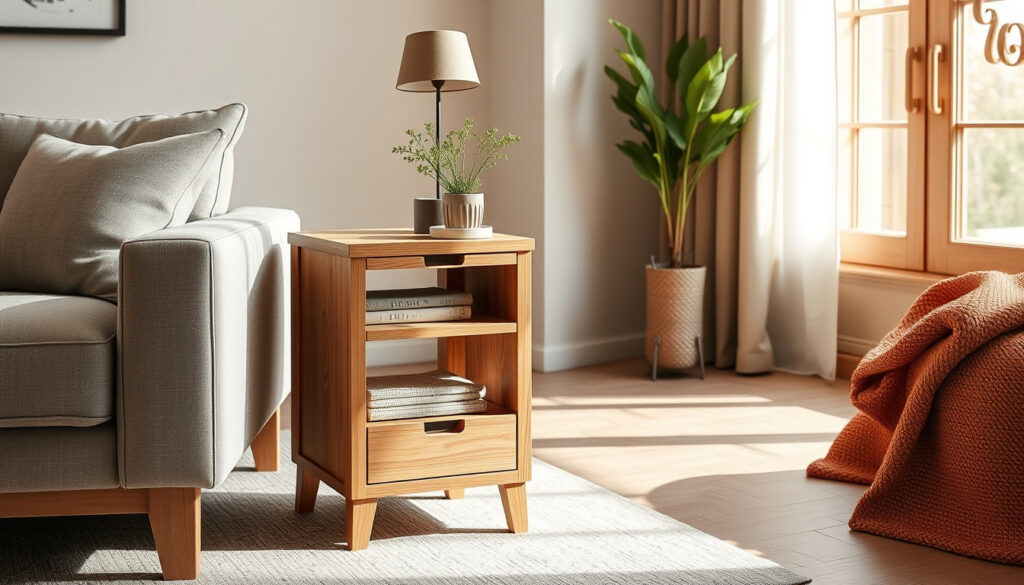
Best Side Table for Living Room: Storage, Wood & IKEA Ireland
If you’ve ever stubbed your toe on a power cord behind the sofa, you already know the case for a side table. In Irish living rooms especially — where space often means choosing furniture that works twice as hard — the right side table can hold your lamp, stash the remote, and tie the whole room together.
Popular Materials: wood, glass, marble · Key Retailers in Ireland: EZ Living, JYSK, Casey’s, IKEA · Common Features: storage, nationwide delivery · Styles Available: traditional, modern
Quick snapshot
- HOL side table (50×50 cm) priced at €60 with solid acacia wood (IKEA Ireland)
- Both HOL models carry 10 kg max load on table top (IKEA Ireland)
- EZ Living offers nationwide delivery on side tables (IKEA Ireland)
- Customer satisfaction ratings not publicly available for most models
- Assembly time estimates vary between retailers
- Stock availability at physical stores differs from online
- IKEA’s STOCKHOLM 2025 collection signals continued investment in premium living room pieces
- Seasonal promotions like HOLMERUD’s price reduction from €50 to €40 appear regularly
- Compact designs gaining ground as Irish homes favour efficient layouts
- Storage functionality increasingly standard rather than premium feature
| Label | Value |
|---|---|
| Top Retailers | EZ Living, IKEA, JYSK |
| Materials | wood, glass, marble |
| Delivery | Nationwide in Ireland |
Side table for living room with storage
The case for storage side tables is straightforward: they’re the furniture equivalent of a multitool. Irish living rooms tend to work harder than their European counterparts — open-plan layouts mean every surface either earns its place or becomes a dumping ground for keys and chargers. Storage side tables resolve this tension by keeping essentials within arm’s reach without sacrificing the clean lines of a well-designed room.
IKEA’s HOL line leads in this category. The standard HOL side table in acacia (50×50 cm) costs €60 and features practical storage space under the lid — suitable for blankets in the hallway or by the sofa or bed. According to IKEA’s product description, the lid design makes accessing stored items effortless while maintaining a clean surface. The larger HOL storage table (98×50 cm) expands that concept considerably, measuring 98 cm long versus the standard 50 cm square, with the same 50 cm height that keeps it proportional alongside most standard sofas. Both models share a 10 kg maximum load on the table top — enough for lamps, books, and daily essentials without concern.
“Solid wood, a durable natural material.”
— IKEA Ireland product description
Storage options in wood and glass
Wood remains the dominant material for storage side tables in Ireland, and for good reason. Solid acacia wood is described by IKEA as a durable natural material that “creates a natural and warm expression in the room.” The fibreboard used for panel components in the HOL line adds structural stability without the weight penalty of solid timber throughout.
- Solid acacia wood construction on HOL line provides durability and natural grain appeal
- Fibreboard panels reduce weight while maintaining structural integrity
- Glass-top storage tables offer a lighter visual footprint but require more careful handling
Top Ireland retailers
EZ Living has carved out a strong position in the Irish market for side tables with storage, particularly through their online catalog and nationwide delivery network. Their range tends towards contemporary designs at competitive price points, with several options undercutting comparable IKEA models. JYSK appeals to budget-conscious buyers with simpler designs that prioritise function over premium finishes. Casey’s occupies the mid-market, offering traditional wooden designs alongside more modern interpretations.
“Find our range of side tables with storage. Keep your essentials close with our side table featuring added storage, combining style and practicality.”
— IKEA Ireland category description
For Irish buyers prioritising storage, IKEA’s HOL line offers the best-documented specifications and build quality. EZ Living provides the broader stylistic range if you want something outside the Scandinavian aesthetic.
Small side table for living room
Compact side tables solve a distinctly Irish problem. Average living room sizes in Ireland have declined steadily over the past two decades, particularly in urban areas where apartments and terraced houses dominate. A 2019 Revenue Commissioners housing report noted that new builds averaged 25% smaller floor plans than those constructed in the 1970s — meaning that furniture chosen a generation ago now overwhelms many contemporary living spaces.
The solution isn’t just buying smaller; it’s buying smarter. The best small side tables for living rooms do one of two things: either they occupy minimal floor space while maximising surface area (think tiered designs or those with open shelves), or they serve dual purposes — a surface that also acts as storage, or a table that can be tucked away when not in use.
Compact designs for tight spaces
IKEA’s approach to small side tables centres on the HOLMERUD model. Available in dark brown at €40 (reduced from €50), it measures 80×31 cm — significantly narrower than the 50 cm square HOL, making it ideal for positioning beside sofas with tight clearance. The elongated proportions work well behind modular sofas where deeper tables would crowd the walkway.
- HOLMERUD at 80×31 cm provides elongated surface in narrow footprint
- Nesting tables from IKEA offer space-saving for flexible configurations
- Round small tables eliminate sharp corner risk in high-traffic areas
IKEA small table options
IKEA’s living room category page lists their full small table range, including nesting tables that tuck away when not needed and rolling tables that can be repositioned easily. The advantage of IKEA’s approach is consistency — all pieces follow their standardized assembly system, and spare parts remain available through their spare parts service. Their Dublin stores and Belfast Click & Collect points make in-person assessment straightforward before purchase.
In a standard Irish apartment living room of 15–20 m², a side table deeper than 45 cm quickly becomes an obstacle rather than an asset. The HOLMERUD’s 31 cm depth represents the practical minimum for lamp-plus-miscellaneous use.
Side table for living room IKEA
When it comes to documented specifications and reliable availability in Ireland, IKEA remains the benchmark. Their product pages list precise dimensions, material compositions, load capacities, and article numbers — data that competitors rarely publish with the same rigour. For a purchasing decision that might last a decade, that transparency matters.
The HOL side table (article 701.613.20) and HOL storage table (article 501.613.21) represent IKEA’s flagship storage side table offerings. Both are designed by IKEA of Sweden, which adds a layer of quality assurance that third-party manufacturers can’t match. The 50 cm height is deliberate — it aligns with standard sofa arm heights, meaning lamps placed on these tables sit at comfortable reading positions without requiring extension cords or awkward stands.
IKEA models in Ireland
Four models merit attention for Irish buyers:
- HOL side table (50×50×50 cm) — €60, solid acacia, 10 kg load, storage lid
- HOL storage table (98×50×50 cm) — larger variant for generous storage
- HOLMERUD (80×31 cm) — €40, dark brown, narrow-profile option
- STOCKHOLM 2025 sideboard — €499, oak veneer, premium tier (161×42×83 cm)
Dublin availability
IKEA Ireland operates a large format store in Belfast and a smaller outlet presence in Dublin, with online ordering covering all 26 counties. Delivery lead times vary by region — Dublin typically sees 3–5 working days, while more remote areas may require 7–10 days. The Click & Collect service at Belfast allows next-day collection for online orders, useful if you’re visiting from Dublin for a day trip.
IKEA’s seasonal promotions can cut 20–30% off regular prices. The HOLMERUD’s current reduction from €50 to €40 illustrates this pattern — buyers who time their purchase around sales save significantly.
Side tables for living room Ireland
The Irish market for side tables breaks roughly into three tiers: budget options under €30, mid-market €30–100, and premium over €100. Understanding which tier you need depends on usage patterns, not aesthetic preferences alone. A table holding only a lamp and a phone charger has different requirements than one expected to absorb daily knocks from children or pets.
What unites the Irish market is the expectation of delivery. Unlike our European neighbours who might cycle to a furniture warehouse and transport pieces themselves, Irish buyers expect delivery to door — and increasingly, room-of-choice delivery. This has shifted the competitive landscape significantly over the past five years.
Local retailers like EZ Living
EZ Living (ezlivingfurniture.ie) has invested heavily in their online presence, offering filtering by material, size, price range, and style. Their side table range spans contemporary minimalist designs in white and oak to more traditional pieces in mahogany and walnut. The advantage of shopping with Irish-owned retailers like EZ Living is customer service continuity — warranty claims are handled domestically rather than through international call centres.
- EZ Living offers extended warranty options beyond statutory requirements
- Irish-based customer service simplifies complaints and returns
- Physical showroom availability in Dublin allows tactile assessment
JYSK and Casey’s options
JYSK (jysk.ie) operates a franchise model with stores across Ireland, making them accessible for buyers who want to see furniture before purchasing. Their side table range prioritises value — simpler designs at lower price points, often with basic materials that serve well for rental properties or temporary setups. Casey’s operates similarly, with a focus on traditional wooden designs that appeal to buyers furnishing period homes or seeking longer-term investment pieces.
JYSK’s value pricing often means accepting simpler joinery and fewer finish options. For primary residence furnishing where the table will see daily use, spending an extra €20–30 at EZ Living or IKEA typically results in better long-term value through durability.
Wood side table for living room
Wood remains the default choice for Irish living room furniture — and not without reason. In a climate where humidity swings between damp winters and dry summers, wood’s natural resilience serves better than engineered alternatives that can delaminate or warp over time. A solid wood side table, properly finished, will outlast the sofa it sits beside.
The choice between wood types narrows the field considerably. Oak offers a lighter grain pattern that suits contemporary spaces; walnut provides deeper brown tones popular in traditional interiors; acacia sits between the two, offering durability with warm undertones. IKEA’s choice of acacia for the HOL line reflects practical reasoning — it’s harder than oak, more resistant to scratches, and achieves a warm tone without the premium pricing of walnut.
Traditional oak designs
Oak side tables dominate the traditional segment. Casey’s stock includes several solid oak pieces with traditional joinery — mortise and tenon joints rather than screws and dowels, which provides both strength and the visual cues of craftsmanship. These tables command premium pricing (typically €80–150 for comparable dimensions to IKEA’s €60 HOL), but the materials justify the difference for buyers seeking longevity.
- Solid oak tables from Irish retailers typically €80–150 for comparable dimensions
- Traditional joinery (mortise and tenon) provides superior durability to flat-pack alternatives
- Oak’s lighter grain suits contemporary and traditional spaces equally
Modern wood finishes
The modern interpretation of wood side tables embraces lighter finishes, cleaner lines, and sometimes mixed materials — wood paired with metal legs or glass tops. EZ Living’s contemporary range exemplifies this approach, with oak-look panels on engineered wood cores providing stability without the weight of solid timber. These hybrid constructions work well in apartments where floor loading matters or where furniture moves frequently between spaces.
The cheapest wood tables (particle board with wood veneer) often cost more over time than mid-priced solid wood. When veneer delaminates, you’re replacing the entire piece — whereas solid wood can be sanded and refinished repeatedly.
Side table specifications
Side tables reveal their quality in the details. Surface finish, joinery method, weight capacity, and material composition tell a more complete story than price alone. The following specifications represent the best-documented options available in the Irish market.
When comparing options across retailers, the HOL line from IKEA offers the most comprehensive specifications, while competitors often omit load ratings and material breakdowns.
| Specification | HOL Side Table | HOL Storage Table | HOLMERUD |
|---|---|---|---|
| Dimensions (L×W×H cm) | 50×50×50 | 98×50×50 | 80×31 |
| Price (EUR) | €60 | Not listed | €40 (was €50) |
| Primary material | Solid acacia | Solid acacia | Particle board/veneer |
| Secondary material | Fibreboard panels | Fibreboard panels | — |
| Max load (table top) | 10 kg | 10 kg | Not specified |
| Storage feature | Lidded compartment | Lidded compartment | None |
| Article number | 701.613.20 | 501.613.21 | Not listed |
| Designer | IKEA of Sweden | IKEA of Sweden | Not listed |
The comparison reveals a clear tier structure: HOL tables offer the best-documented specifications with transparent materials and load ratings, while competitors often omit these details. The 10 kg load capacity shared by both HOL models should accommodate most living room use cases — lamps, books, drinks, and daily essentials without concern.
Side table pros and cons
Upsides
- Storage side tables reduce clutter in high-traffic areas
- Solid wood options (acacia, oak) provide decades of service with proper care
- Compact designs accommodate Irish apartment-sized living rooms
- Nationwide delivery from EZ Living and IKEA simplifies purchasing
- HOL line’s 10 kg load rating accommodates most lamp-and-essentials configurations
- Multiple retailers compete, keeping prices accessible across budget tiers
Downsides
- Self-assembly required for IKEA models; assembly service costs extra
- Particle board tables (budget tier) fail faster under frequent use
- Delivery lead times to rural Ireland can reach 7–10 days
- Limited documented specifications from most competitors outside IKEA
- Smaller footprint tables sacrifice surface area for space efficiency
- Humidity sensitivity in older Irish properties may affect some materials
The trade-off that matters most: solid wood costs more upfront but performs better over time. In rental situations or temporary setups, budget particle board tables make sense. For anyone furnishing a primary residence expecting to stay five-plus years, the additional €20–40 for solid wood pays dividends in longevity.
Related reading: Side Tables for Living Room: Best Options in Ireland · Capital of Northern Ireland: Belfast Facts, History & UK Role
The right side table proportions transform daily sofa interactions, as explored in this guide to sizes, shapes and trends essential for Irish living rooms.
Frequently asked questions
How tall should a side table for living room be?
The standard recommendation is 50–55 cm, aligning with typical sofa arm heights. IKEA’s HOL line uses exactly 50 cm, which positions lamps at comfortable reading height without requiring extension cords or tall bases.
What shape side table for living room?
Round tables eliminate sharp corner hazards in high-traffic areas. Square tables maximise surface efficiency in corner placements. Rectangular tables like the HOLMERUD (80×31 cm) suit narrow spaces beside sofas. Choose based on your room’s traffic patterns and available floor space.
Side table for living room with drawers?
Storage side tables typically use lidded compartments rather than drawers — the lid design in IKEA’s HOL line provides easier access than drawer mechanisms while maintaining clean exterior lines. Drawer construction adds cost and complexity without significant functional advantage for most living room uses.
Metal side tables for living room?
Metal side tables appear in contemporary ranges from EZ Living and JYSK, typically with hairpin legs or industrial frames supporting wood or glass tops. These suit modern interiors but lack the warmth of wood in traditional spaces. Metal frames may scratch flooring and can feel cold to touch in unheated rooms.
Marble side tables for living room?
Marble side tables occupy the premium tier (€100+) and appeal to buyers seeking statement pieces. The material’s weight makes delivery trickier and placement more permanent, while porosity requires sealing and careful maintenance to prevent staining. Marble suits traditional spaces with consistent heating; temperature fluctuations can cause hairline cracking over time.
Round side table for living room?
Round side tables offer distinct advantages in family homes: no sharp corners to cause injuries, and the curved profile integrates more fluidly in open-plan spaces. The trade-off is typically smaller surface area — a 40 cm diameter round table provides less usable space than a 40×40 cm square.
Nesting side tables for living room?
Nesting tables provide flexibility for rooms that serve multiple purposes or where one table occasionally needs to disappear. IKEA lists nesting tables in their living room range — typically two or three tables that nest together when not in use, expanding to provide surface space when needed. They’re ideal for studio apartments or rooms used for both relaxing and working.
More related posts
 TikTok Seller Center UK Registration, Login & App Guide
 Herpes Photos in Different Stages – Visual Stages from Prodrome to Healing
 Metals Exploration Share Price: Buy or Sell? Forecast & News
 Elder Scrolls Oblivion Remastered – Key Features and Release Details
 Oppo Find X9 Pro: Price, Specs, Review, US Compatibility
 Easter Opening Times for Tesco Supermarkets 2026
 I’m a Celebrity 2025: Angry Ginge Wins, Cast & Schedule
 Part Time Jobs Leeds: Your 2025 Guide to Finding Work in Leeds